
The drive starts after the bag is zipped
Packing is its own job: the usual food, daily meds and a photo of records, a leash and tags with a current number, and bags plus something that smells like home. Do that list before you lock the door. What follows is how the ride and the day out work — the part a checklist cannot drive for you.
Keep the first real outing smaller than the day you would take alone. One destination. A stop you chose on purpose. A turnaround time that still leaves shade and patience for the ride home. Stacking a long hike on a long drive is how a willing dog becomes a miserable one.
A restraint that actually holds
In a hard stop, a loose dog is a weight in motion, and so is anyone they hit. Two setups hold. One is a harness built for the car, clipped to the seat belt with its tether, in the back seat. The other is a crate that is strapped or braced so it cannot become a projectile. A collar clipped straight to a belt can hurt the neck. A lap is not a restraint. “They just lie there” is not a restraint either.
Fit it in the driveway. You should not be able to pull the dog backward out of the harness, and it should not dig into the armpits. Then take a ten-minute loop before the day you care about. If the dog spends that loop fighting the gear, you do not have a travel setup yet. You have a project.
If the dog already rides in a crate, secure that crate and keep using it. Teaching a dog to like a crate is a different job — see crate training without tears if you are starting from zero. This page does not reteach it. Getting a stiff dog up into the car is a different job too — see senior dog mobility at home for ramps and a lift, not for the seat belt.
A car harness we’d consider
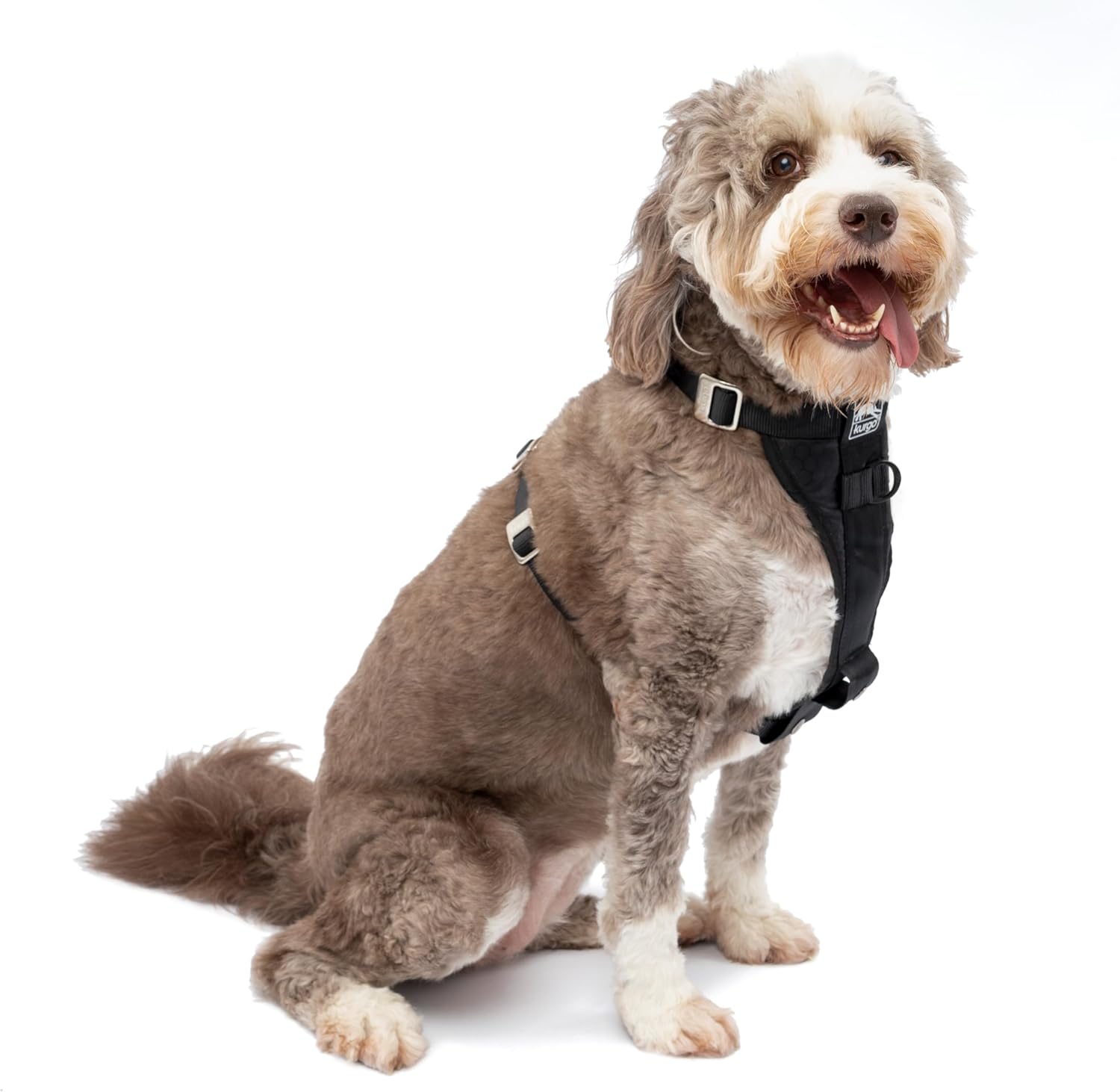

The specific pick for the seat belt is the Kurgo Enhanced Strength Tru-Fit Smart Harness in black, size Large. The listing calls it a crash-tested car harness for dogs up to 75 lb, with five adjustment points, a padded chest plate, all-steel buckles, and a 10-inch seatbelt tether with a steel carabiner. The size chart on that page lists Large at 50–75 lb, chest 24–34 inches, neck 18–30 inches. It was at 4.4 stars from 7,846 ratings when we checked Amazon US on October 4, 2026. Shoppers praise the build and how it keeps a dog in place while driving. They also split on security: some say it stays put, others report a dog slipping out, and the clasps get mixed notes, including buckles some people find tricky. Measure first, and do not treat the listing’s 75 lb crash-test note as coverage for a heavier dog. A harness lowers the odds of a loose dog. It does not make a crash harmless.
Stops, on purpose
Decide the stop before you need it. A rest area, a shady side street, or a pet-welcome shop beats hunting for a spot while the dog is already beside themselves. Get out, sniff, drink, and give everyone a few minutes that are not the highway. Then get back in before the stop turns into a second adventure.
- Offer water at the stop, not only when you arrive at the destination.
- Keep the leash on. A new place is not the day to test recall.
- Skip a huge meal right before you roll. A light stomach rides easier than a full one.
- If the dog is doing fine, you can still stop. Waiting for a crisis is how the trip unravels.
Heat, shade, and the parked car
Run the air conditioning. Park in shade when you stop, and do not leave the dog in the car while you “just run in.” A cracked window does not keep a parked car safe. Pavement cooks paws: if you cannot hold the back of your hand on it for a few seconds, do not ask the dog to stand there.
Watch the dog, not the clock. Heavy panting that does not ease in the cool car, thick drool, a dazed look, vomiting, or collapse is an emergency. Move to shade, offer cool water, wet the belly and paws if you can, and call a vet. Gear does not treat heatstroke.
The car is also not a crate you park outside a store. If the question is how long a dog can be left alone at home, that is a different guide: how long a dog can be left alone. A closed car in a lot is not that answer.
Water for the pause, and for the day
Bring the water. A bowl only holds what you pour. On a warm day a dog can empty a small cup and still need more before you are back at the car. Carry a bottle you can refill, and treat the bowl as the thing you set on the ground so they are not drinking from your hand over a parking space.
A travel bowl we’d consider
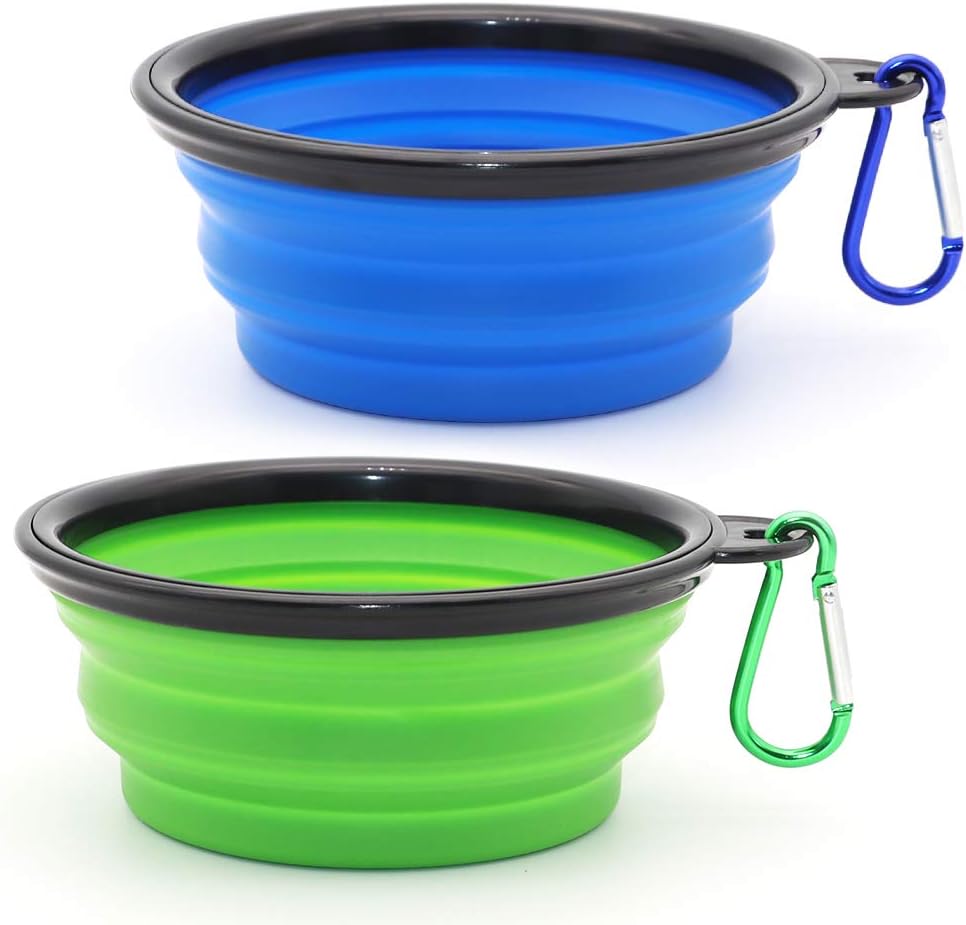

The specific pick for the stop is the SLSON 2-pack listed as Dog Bowl Pet Collapsible Bowls, small, blue and green, with two carabiners. The listing says each bowl holds up to 12 fluid ounces, folds flat, and is dishwasher safe, and that the small size suits small to medium dogs. Brand on the listing is SLSON; material on the listing is plastic. It was at 4.7 stars from 31,095 ratings when we checked Amazon US on October 8, 2026. Shoppers call them handy for car trips and walks. Durability is mixed: some say the bowls hold up, others report that the carabiners break quickly. A 12-ounce bowl is a pause cup. It is not the day’s water supply, and it is a poor only-bowl for a large dog.
Dog Bowl Pet Collapsible Bowls, 2 Pack, Small, Blue and Green
Pace the day like the dog is coming
You will move slower. That is the trip. One good walk or one good view is plenty the first time. Build in the ride home while everyone is still pleasant, not when the dog is cooked and you are late. If the destination does not allow dogs inside, know that before you leave, and do not “solve” it by leaving the dog in the car.
A familiar blanket on the seat can help. So can a toy they already love. New smells are the enrichment. You do not need a new routine invented in the parking lot.
If the dog is carsick
Motion sickness looks physical: lip licking, heavy drool, yawning, then vomit. It often shows up on curvy roads or in the first months of riding, and it is not the dog “being difficult.”
- Skip a big breakfast. A light stomach usually rides better than a full one.
- Cool air helps. Crack a breeze if it is safe, and keep the cabin from getting stuffy.
- Face the dog forward and keep them restrained. Letting them climb into a lap to “feel better” trades one problem for a loose dog.
- Stop, clean up, and give water in small offers once the retching stops. Do not push another hour to “get it over with.”
- Short, dull trips that end somewhere pleasant teach the car faster than one awful highway day.
If vomiting is frequent, bloody, or paired with lethargy when you are not in the car, call your vet. Ask them before any motion-sickness medicine. This page will not name a product or a dose for that.
If the dog is anxious about the car
Anxiety looks like the ride itself is the threat: panting, pacing, whining, or refusing to get in before the car has even moved, often without vomit. Drool can show up here too, so watch the whole picture. A dog who is only sick on curves is not the same dog who panics in the driveway.
- Sit in the parked car with the door open. Treat, chat, get out. No engine.
- Then engine on, still parked. Then a two-minute loop that ends at home or somewhere they like.
- Do not make every trip the vet. If the car only predicts scary rooms, the dog learns the right lesson.
- Keep the restraint on for the short trips too, so “practice” and “real” feel the same.
Worry about being left alone is a different problem from worry about the moving car. If the distress shows up when you walk away, start with separation anxiety red flags and first steps. If the dog cannot settle for even a parked-car session, a trainer or vet who sees behavior cases is the next call. A new bowl will not fix that.
New pieces land in the newsletter — subscribe on the homepage.
Related reading on ATGD
- How long a dog can be left alone — home time, not a parked car
- Separation anxiety red flags and first steps — when the fear is you leaving
- Crate training without tears — if a secured crate will be the restraint
- Senior dog mobility at home — getting in and out when joints make the hop hard
- More lifestyle and living guides
Bottom line
Travel with a dog gets quieter when the ride has a real restraint, stops you planned, cool air, and enough water for the day you actually have. Practice short before you practice long. Treat carsickness and car anxiety as different problems, and call a vet when either one is bigger than a single rough trip. The bag you packed gets you out the door. How you drive is what gets everyone home still glad they went.