
The claim
The pitch from fresh “human-grade” brands is easy to hear: food that looks like your dinner must be better for your dog, and a caring owner pays for it.
In an essay for The New York Times Magazine (November 10, 2026), writer Amy X. Wang pushes back. She describes six years with Poca, a three-legged rescue mutt, and an industry she says keeps telling owners they are not doing enough.
Wang writes that several fresh-food subscriptions she was “guilted into buying” averaged out to about $68 a week. That came to $3,536 a year, more than she spends on her own groceries, so she stopped. When she gave a newer start-up another try, she thawed the first packet and, in her words, her dog “scarfed it in about 13 seconds flat.” Her partner later texted that Poca did seem to like it, but had also tried to eat stale pizza on the curb that morning, and a dead pigeon.
Her argument is that the marketing is aimed at the person holding the bowl. She notes that the recipes are almost always some mix of meat, peas, rice and berries, and that each brand sells its own look and lifestyle. Newser summarized the essay on November 15.
What the research says
The label rule. The Association of American Feed Control Officials (AAFCO) has a standard for “human grade” pet food claims, announced in January 2023. It says the claim has to apply to the whole product, that every ingredient and the finished food must be stored, handled, made and shipped in line with federal rules for human food, and that the words must sit next to what the product is, as in “human grade dog food.” The claim is voluntary. So “human-grade” tells you about the supply chain and the kitchen. It does not, on its own, tell you whether a recipe is balanced for your dog.
The line that covers nutrition. For that, the FDA points owners to the nutritional adequacy statement. If it says “complete and balanced,” the food is meant to be your dog’s only diet. To make that claim, a dog food must either meet one of AAFCO’s nutrient profiles or pass a feeding trial using AAFCO procedures, and the statement names a life stage, such as growth or adult maintenance. AAFCO’s guide to reading labels notes it is usually on the back or side of the package, in small print.
A small study of human-grade food. A 2021 University of Illinois study in the Journal of Animal Science fed 12 dogs four diets in turn: one kibble, one fresh food and two human-grade recipes. The human-grade recipes it tested were more digestible and the dogs produced less stool than on the kibble, while blood work was not greatly affected. The paper says the study was funded by the human-grade brand whose recipes were tested, and the authors write that more research is needed on possible long-term health benefits.
A review of the evidence. A systematic review published in Animals in December 2025 looked at marketing claims made for fresh pet food. It found only six studies comparing human-grade with feed-grade ingredients, and said they had methodological limits and a high risk of bias, including industry funding. The authors concluded that the superiority of human-grade ingredients “remains inadequately investigated.”
What vets’ groups suggest instead. The World Small Animal Veterinary Association’s nutrition committee says on its nutrition guidelines page that the ingredient list tells you nothing about ingredient quality and can be misleading. Its guide to selecting a pet food suggests asking a brand who formulates its diets, whether it employs a qualified nutritionist, and what quality control it runs.
What we don’t know yet: whether human-grade food helps dogs live longer or healthier lives. The studies so far are small and short, and most of the ones comparing ingredient grades were industry-funded. We will update this page if better research comes out.
We looked at another popular label claim in grain-free vs regular dog food.
What we’d do
- Read the back of the bag first. Find “complete and balanced” and the life stage before you look at the front.
- Ask your vet how much to feed. Then measure it the same way every day.
- If the brand matters to you, ask it the WSAVA questions: who formulates the food, and what quality control it runs.
- Slow down a fast eater with a slow-feeder bowl.
None of these picks is a food, and none of them settles the nutrition question. They are simple tools for measuring a meal and making it last. Check the current price and size on each listing before you buy.
Our pick for a fast eater: Outward Hound Fun Feeder Slo Bowl
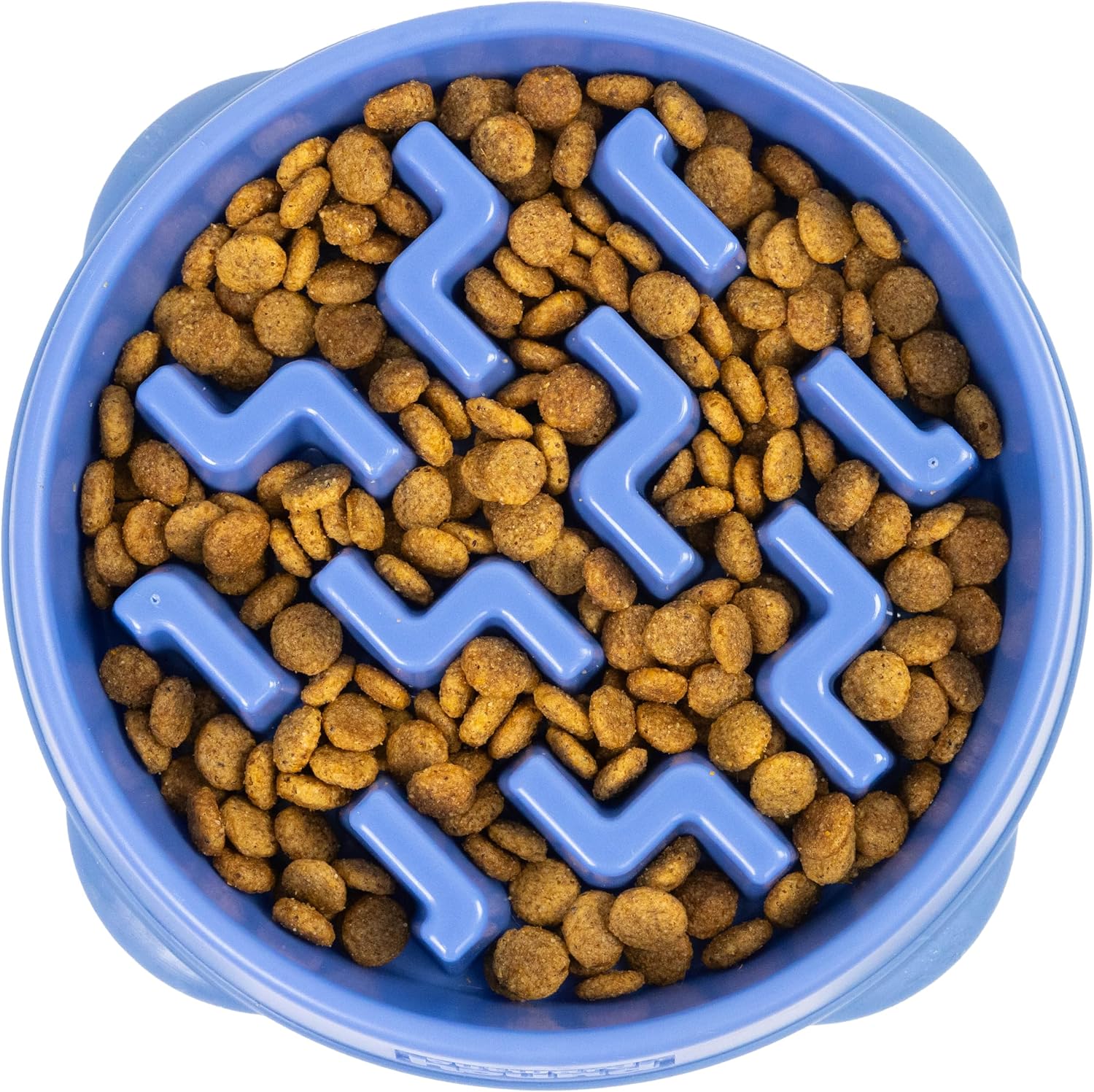
Best for: the listing says this medium bowl is designed for small to medium dog breeds and holds 2 cups of dry or wet food. The size picker also offers Small and Large, and the listing says the bowls come in several maze patterns and three slow levels.
The listing says the bowl is non-slip and top-rack dishwasher safe. Amazon’s review summary says customers find it easy to use and say it slows down fast eaters.
Our pick for measuring portions: OXO Good Grips food scale

Best for: owners who want to weigh the amount on the bag or the amount their vet gives them. The listing describes an 11-pound scale with a pull-out display, a zero button for subtracting the bowl, and readings in grams, ounces, pounds and kilograms.
The listing says four AAA batteries are included and the platform comes off for cleaning.
New pieces land in the newsletter. Subscribe on the homepage.
How fast does your dog finish dinner? Tell us on Instagram @all_the_good_dogs.
Related reading on ATGD
- Grain-free vs regular dog food: what the science actually says
- Thanksgiving foods your dog can share, and the ones to skip
Sources
- Amy X. Wang, “Who Is ‘Human Grade’ Dog Food Really For?”, The New York Times Magazine, November 10, 2026 (essay): nytimes.com
- Newser, “Human-Grade Dog Food Isn’t Really for Dogs,” November 15, 2026 (summary of the essay): newser.com
- Sungho Do, Thunyaporn Phungviwatnikul, Maria R. C. de Godoy and Kelly S. Swanson, “Nutrient digestibility and fecal characteristics, microbiota, and metabolites in dogs fed human-grade foods,” Journal of Animal Science 99(2), 2021 (peer-reviewed; funded by JustFoodForDogs): pmc.ncbi.nlm.nih.gov
- Matthew T. Jobe and Kevin M. Downs, “Systematic Review and Meta-Analysis of Quality Claims Associated with Fresh Pet Food,” Animals 16(1), 41, published December 23, 2025 (peer-reviewed; no external funding): mdpi.com
- AAFCO, “AAFCO Standard for ‘Human Grade’ Pet Food”: aafco.org (PDF)
- AAFCO, “New Standards for Human Grade Pet Food,” January 12, 2023: aafco.org
- AAFCO, “Reading Labels”: aafco.org
- U.S. Food and Drug Administration, “‘Complete and Balanced’ Pet Food”: fda.gov
- WSAVA Global Nutrition Committee, “Nutrition Guidelines”: wsava.org
- WSAVA Global Nutrition Committee, “Selecting a Pet Food for Your Pet” (2021): wsava.org (PDF)